
Hi there,
A weird pattern I keep noticing in conversations with business owners. The people who say their team is using AI well almost never know what their team is actually doing with it. The ones who say their team is rubbish at AI usually have one or two people quietly producing genuinely good work, often without telling anyone.
So this week, instead of a take on the news, a small invitation. Have an honest look at who’s actually using AI in your business and how. The answer is probably surprising.
This week in AI
Two stories worth your attention this week. One quiet, one practical.
The quiet one. Microsoft confirmed last week that paid Copilot users have crossed 20 million, up from 15 million in January. Weekly Copilot usage inside Microsoft 365 is now on a par with Outlook itself. That is the line worth pausing on. It means a meaningful chunk of UK office workers are now reaching for AI as often as they reach for email, whether their employer has a strategy for it or not. If you have Microsoft 365 in your business, your team is in that 20 million somewhere. The question is whether they are using it on real work or whether they tried it once, didn’t get much back and quietly stopped.
Worth remembering that we have spent decades learning how to use email. We know when to reply, when to bcc, what a polite tone looks like and what a passive-aggressive one looks like. Copilot is a new category of tool with new behaviours, and almost nobody has been taught any of them. That is the gap between paying for Copilot and getting value from it. It is not the licence. It is the training.
The practical one. Microsoft’s price increase on Microsoft 365 hits on 1 July. Most plans go up 5 to 15 percent, frontline worker plans up to 33 percent. Existing customers can lock in current pricing by renewing before then, which in practice means kicking off the conversation with your IT provider by mid-June. Worth a calendar reminder.
The practical bit
The Three-Check Habit
Before you send an AI-generated email, copy a ChatGPT answer into a doc, or paste a Copilot summary into a meeting note, run it past three questions. In order. Takes thirty seconds.
- Is anything in here factually wrong?
Read for confident-sounding statements. Names, numbers, dates, claims. If the AI wrote it like a fact, check it like one.
- Would I have phrased it this way?
Not “is it grammatically correct,” but “does this sound like me.” If it has a phrase you’d never use in real life, swap it.
- What’s the one thing it missed?
AI gives you the average answer. Yours is supposed to be better than average. The thing it missed is usually the thing your reader actually needed.
Three questions, thirty seconds, every time. The output is no longer “what AI said,” it’s ”what you sent.” That distinction is the whole game.
Go deeper
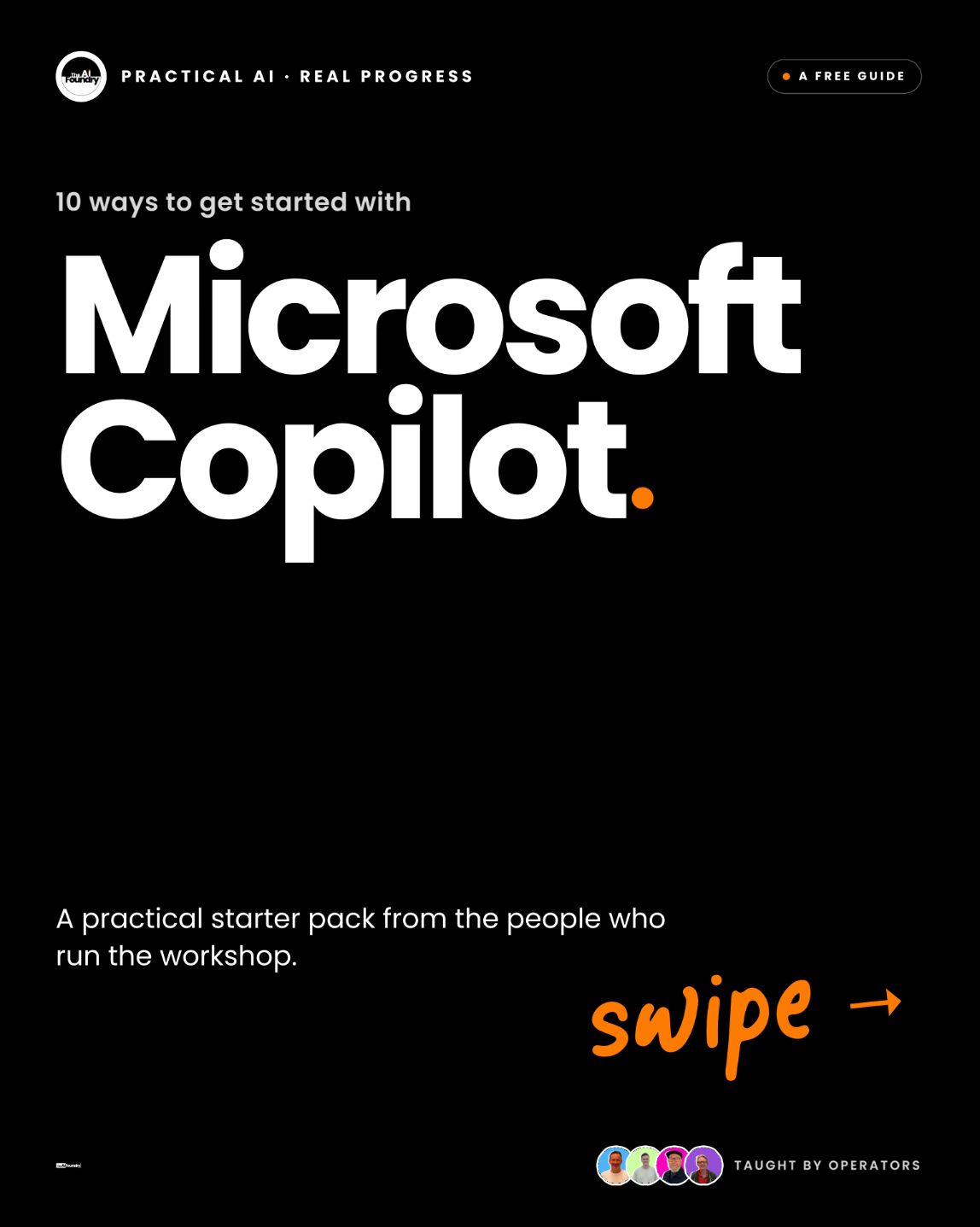
10 ways to get started with Microsoft Copilot
A free guide on where to start with Copilot. Same direct approach, ten places to apply it.
What’s on
The sessions below ran in May 2026. For what is coming up, see upcoming events.
Build Along with AI
Thursday 4 June · White City, London
A hands-on session where you leave with a one-page AI roadmap and a draft AI policy for your business.
With guest speakers
Mahdi Sharif
Humble AI
Hannah Morris
Let’s Trailblaze
Join the free Foundry community
Peer discussion, weekly resources and first access to events and sessions. No fee, no pitch.
If you do have that look this week, brace for some surprises.
The team member you assumed was leading the way is often using ChatGPT for one task and nothing else. The quiet senior person you wrote off as a sceptic is often building elaborate workflows and not telling anyone. The middle bit of the org chart, where the actual work happens, is mostly winging it.
None of this is a problem on its own. It becomes a problem when you start making decisions based on what you assume is happening. Buying licences for tools nobody’s been trained on. Paying for an enterprise tier when most users are still in the free version. Investing in advanced training for people still googling the basics.
The single most useful hour you can spend on AI in your business this month is asking five people what they actually use it for. Not in a meeting. One at a time. Quietly.
Hit reply and tell me what surprised you most when you went looking. We read every one.
Know someone running a team in the dark? Forward this on. That’s how this list grows.
What people say they do with AI and what they actually do are rarely the same thing.
Richard